Sunday, 4 January 2009

BACK TO NORMALITY

Ok so that's the Christmas and New Year Break over, and tomorrow its back to normal going to work in the dark and coming home in the dark. So no time for taking Photos. Still I have a large library so will try to get something on. In the meantime may I wish all visitors to my blog a very Happy Peaceful & Prosperious New Year 2009.

BIRD OF THE DAY- THE COOT

These two images were taken yesterday on the local reservoir at Stithians and show the Coot, a waterfowl that is very abundant on most streaches of water in the UK.
You can always hear them calling and squabbling almost non stop. not the most handsome of birds but I think these shots do it justice.
For more great images of birds at Stithians take a look at Stithians- birding blogspot (link on left hand side of page) where the Warden Simon Taylor is a great blogger.

THE CARRICK ROADS

Got up nice and Early this morning and drove to a place called Loe Beach on the River Fal to look for some overwintering birds.
The sun had risen about 30 mins earlier,so I think I missed a great sunrise , there was still enough early light, so I set up the camera to slightly under expose the image to give it a strong silhouette.
This streach of water is called The Carrick Roads and is the estuary where the River enters Into The English Channel.
The Shot on the right was taken a short time later and shows the river bank towards the Port of Falmouth.
During the summer all of the mooring bouys would be filled with boats, as this is a very popular launching point for water activites.
I still managed to see the birds, Black Necked Grebes/ Red Breasted Mergansers /Common Scoters and was also rewarded with two unexpected Velvet Scoters

Saturday, 3 January 2009

BIRD OF THE DAY

These two images are of the Redshank,which is one of the commonest waders found on the beaches and estuaries in the county.
The left photo was taken on the beach at Marazion, whilst the right one is on the Hayle Estuary

ITS A HARD LIFE

These two pictures show that it is possible to survive in the harshest of environments.
The left photo shows a clump of Sea Ivory,and the right one a patch of the lichen Yellow Scales clinging to the hard Cornish Granite which are the main rock formations found in the county.

Friday, 2 January 2009

MINING HISTORY

Cornwall used to be the world centre for Tin and Copper mining, and at its height in the Mid 1800.s until the 1930,s was the main producer of the metals.
The top picture shows a reconstruction in June 2008 by preservation society ,s who smoked up 21 chimneys in the Redruth/Camborne area. the picture shows five stacks in the Carnkie area.
Pictures 2 & 3 are of Wheal Francis Mine near Four Lanes, and show how they would have looked on a bright sunny day ,and a clear moonlight night.
The final two shots are of two restored Engine Houses ,The East Pool and Agar stacks showing the Cornish Beam Engines.

BUFF ERMINE & WHITE ERMINE MOTHS

This is another part of Photography I enjoy, During the summer months I set my home made moth trap in the back garden.
It never fails to amaze me how beautiful some moths are.
Here we have a White & Buff Ermine, these are Photographed early in the morning while they are still docile.
all are returned back to the wild unharmed.

NORTH CLIFFS

The North Cliffs are an area on the Atlantic coast, It stretches from St Agnes to Godrevy in St Ives Bay. The Cliffs here are very rugged, and average 100m high.
This is the home of the Peregrine Falcon, and various other seabirds including Cormorants, Shags, and a number of Gull species, including Fulmers which breed during the summer.
Sadly it is also the graveyard for a large number of ships that have been caught out by the ferocious Winter storms over many years.
But as you can see during the summer it offers great walking and exhilarating views.

Thursday, 1 January 2009

PEREGRINE FALCON

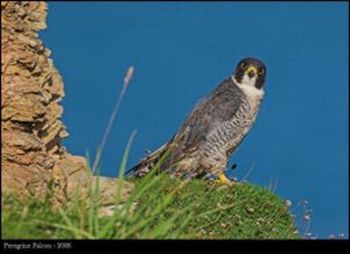
This is without doubt my favourite bird, I was walking along the North Cliffs near Hells Mouth where these are resident. I saw this one land and managed to get within 5 metre,s as it sat on the cliff edge. It looked straight at me as if to say ,what are you doing here.I got 6 great shots before it flew off.

ST MICHEALS MOUNT

Probably the most famous view in Cornwall, St Micheals Mount is located on the south coast. It is accessible at low tide by a stone causeway from the town of Marazion,and at high tide by a ferry.